
The right decision is not custom versus standard in the abstract. It depends on the journey, integrations, operational risks and level of ownership your organisation needs.
The short answer
A standard platform is often the best starting point when the call journey is straightforward and the available integrations meet the organisation’s needs.
A custom architecture becomes relevant when the organisation must exercise precise control over conversations, business rules, internal system connections and recovery mechanisms.
When is a standard platform enough?
For incoming call reception, answers to frequently asked questions or straightforward appointment requests, an existing solution can reduce implementation time.
Its functional, contractual and technical limits still need to be verified against the real call journey. Fast configuration is useful only if the resulting service can be operated, supported and changed safely.
When should you consider a custom architecture?
A custom approach becomes relevant when several constraints need to be addressed at the same time:
- 01Connections to several business systems.
- 02Complex conversational journeys and business rules.
- 03Security and confidentiality requirements.
- 04Handling of sensitive or exceptional situations.
- 05Handoff to human operators with useful context.
- 06Supervision, logging and traceability.
- 07Service continuity, fallback and degraded operating modes.
Standard, custom or hybrid?
| Decision area | Standard platform | Custom architecture | Questions to verify |
|---|---|---|---|
| Journey | Best suited to bounded, repeatable paths supported by the product. | Can model specific rules, permissions and exceptions. | How many exceptions and handoffs exist in the real journey? |
| Integration | Native connectors and webhooks can shorten delivery. | APIs, identity, permissions and orchestration can be designed around internal systems. | Which systems are critical, and what happens when one is unavailable? |
| Control | Controls depend on product features and configuration. | Approval, safe stop, audit traces and human takeover can be designed explicitly. | Which action requires approval or must never be autonomous? |
| Operation | The organisation adopts the platform’s release, support and observability model. | Responsibilities and tooling can be tailored, but must be funded and maintained. | Who monitors, changes and supports the service after launch? |
| Economics | Lower initial configuration can suit a simple scope; usage and add-ons remain recurring. | Higher discovery and integration effort may be justified by specific operational value. | What is the total cost across build, usage, support, change and exit? |
| Exit | Data export, number portability and migration depend on the contract and product. | Ownership can be defined more precisely, but suppliers and components still create dependencies. | Can you retrieve data, prompts, logs, numbers and integration specifications? |
Why architecture matters as much as the AI model
The quality of a voice agent does not depend solely on the language model it uses.
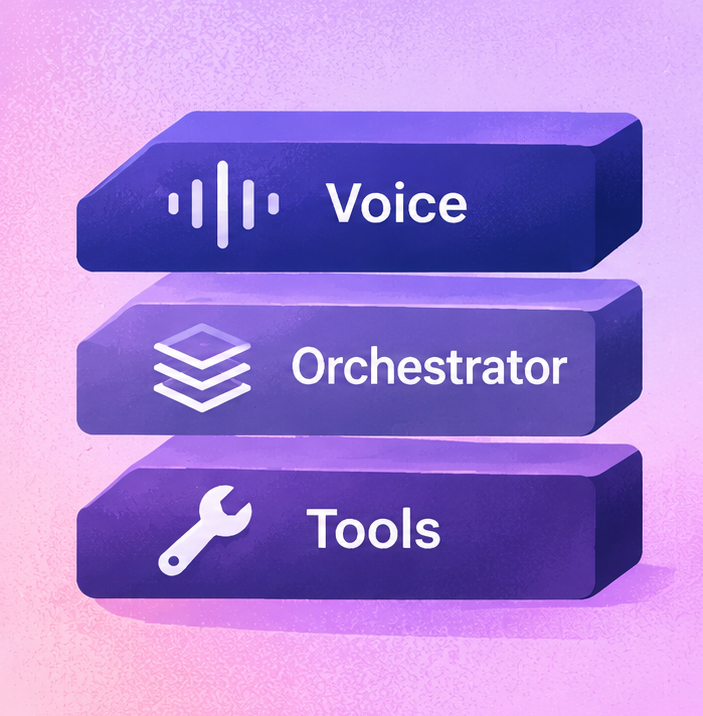
It also depends on telephony, speech recognition, voice synthesis, orchestration, business rules, identity, permissions and the tools the agent is authorised to access.
A reliable system must explicitly define what happens when the AI does not understand, when information is missing, when a transfer fails or when an external service becomes unavailable.
Compare the total cost of ownership
- 01Discovery, configuration and implementation.
- 02Telephony, speech, model and platform usage.
- 03Connectors, API maintenance and changes to business systems.
- 04Testing, monitoring, human supervision and incident response.
- 05Support, security updates and continuous improvement.
- 06Migration, data export, number portability and supplier exit.
The least expensive prototype is not necessarily the least expensive service to operate. Conversely, a custom architecture is not automatically safer, more reliable or more cost-effective: the outcome depends on design, testing, suppliers, operating discipline and contractual responsibilities.
Define ownership before signing
- 01Who owns the telephone numbers, call flows, prompts and integration specifications?
- 02Who can change permissions, approved sources and fallback rules?
- 03Which logs, transcripts and performance data can be exported?
- 04Who responds to incidents and approves releases?
- 05What remains usable if a provider, model or connector changes?
The Banana Navy approach
We design voice AI systems in which conversational components, integrations and control mechanisms are considered together.
The objective is to deploy agents that address real operational needs, with documented behaviour, explicit limits, an appropriate supervision model and a practical path for future change.
Conclusion
The choice between a standard platform and a custom architecture should not be based on a general technology preference.
It should follow from your operational needs, risks, existing infrastructure, ownership requirements and ability to run and improve the service over time.
Continue your evaluation
Architecture decision guide, not a claim that custom development is inherently safer, more reliable or more cost-effective. Outcomes depend on design, testing, operations, suppliers and contractual responsibilities.
Choose the architecture that fits the work — not the trend.
Let's talk
- marc@banana-navy.com
- Phone
- +32 495 27 70 44
- Studio
- Banana Navy SRL
Rue Antoine de Saint-Exupéry 2
6041 Charleroi (Gosselies), BelgiumVAT BE 0745.575.058