
A fluent voice agent can still be fragile. A secure conversational infrastructure treats every exchange as a complete operational chain: channel, signal, knowledge, decision and action remain separately observable and controllable.
In brief
- 01Security does not live inside the model: access, signal, knowledge, actions and traces are controlled separately.
- 02The conversational engine proposes; deterministic rules authorise, limit or block the action.
- 03When uncertainty rises, the system must stop, explain its limit and hand over to a person or a tested continuity path.
The model speaks. The infrastructure decides what it may know, say and trigger.Architecture principle
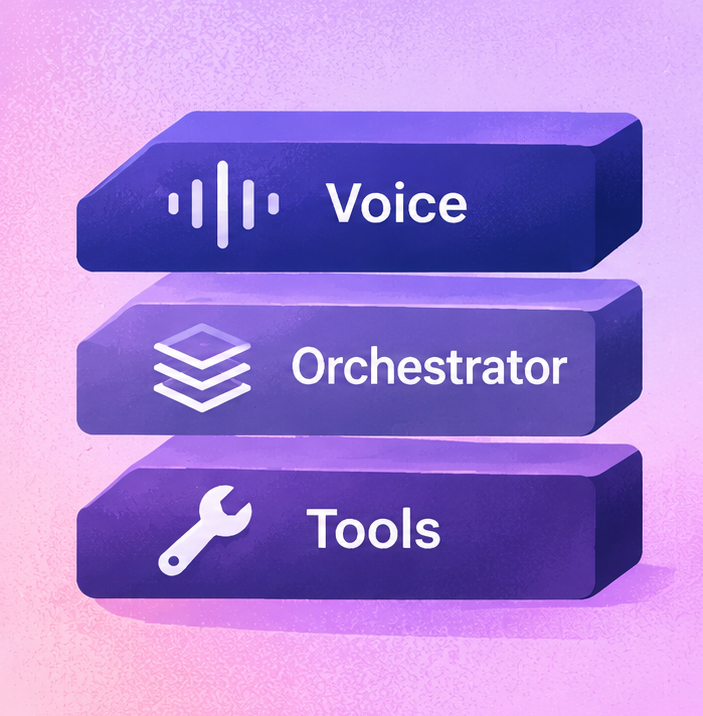
Seven control points, from call to action
The output of one stage becomes the input of the next, but it is never accepted blindly. Each layer verifies, limits or enriches what it receives.
- 01Channel & session ›A call enters through an approved line, WebRTC interface or other channel. Session establishment, routing and AI disclosure remain explicit.
- 02Admission & availability ›Capacity, repeated use and abnormal behaviour can be filtered before they consume the conversational engine.
- 03Audio signal ›Speech, silence, noise and transcription quality are assessed so an unstable signal does not automatically become a business decision.
- 04Business understanding ›Language, intent and context are interpreted inside an authorised scope. Understanding a request does not grant permission to act.
- 05Approved knowledge ›Sensitive information carries a source, version, validity period and, where needed, an explicit geographic scope.
- 06Decision & action ›Deterministic policy applies priorities, permissions and stop thresholds before a reply, notification, update or human transfer.
- 07Trace & supervision ›Useful events, policy versions, decision paths and outcomes are recorded under the system's retention policy.
Defence in depth: three responsibilities
Controls work together, sometimes in parallel. A weakness at one level must remain visible to the others instead of being hidden by a convincing answer.
- 01Telecom & access
Protects the entry point, capacity, sessions and authorised channels.
- 02Conversation & knowledge
Keeps dialogue within scope and separates validated content from free model generation.
- 03Decision & operations
Authorises outputs, enforces stop thresholds and organises human takeover or continuity.

What external frameworks reinforce
This layered model is a Banana Navy engineering pattern, not a certification. It aligns with several authoritative references when they apply to the use case.
- 01The EU AI Act requires people to be told when they interact directly with an AI, unless that is obvious from the context (Article 50). For systems classified as high-risk, Articles 12, 14 and 15 add requirements for logging, human oversight, accuracy, robustness and cybersecurity.
- 02The NIST AI Risk Management Framework treats governance, mapping, measurement and management as continuous lifecycle functions, including monitoring, override, recovery and safe failure beyond knowledge limits.
- 03OWASP's Excessive Agency guidance recommends minimising tool functionality, permissions and autonomy, requiring approval for high-impact actions, and enforcing authorisation in downstream systems rather than asking the model to decide.
Sensitive demos make the rules visible
Our nuclear and flood technology pages describe target architectures and prototypes. Their value is to expose which decisions must remain explicit before production.
- 01Current information has authority
A live nuclear instruction is usable only when its source, approval, dates and area of application are known. A historical fact never becomes a current alert.
- 02Found is not confirmed
Matching an address in a flood register is not enough: the caller must confirm it. Failed verification preserves uncertainty instead of inviting a guess.
- 03Scope is a safety function
The voicebot does not predict, diagnose, invent local advice or replace official emergency channels. It can say that verified information is unavailable.
Degraded mode is a behaviour, not a sentence
A useful fallback is not generic wording added to a prompt. It is a testable architecture decision linked to signal quality, source availability, permissions and tool state.
- 01Bound the answer
Reduce the response scope and state what could not be verified.
- 02Hand over
Transfer with useful context when risk, doubt or policy reaches a defined threshold.
- 03Continue safely
Activate a pre-agreed procedure when a model, API or critical source is unavailable.
- 04Reject stale guidance
A missing valid instruction must not silently reactivate the last known one.

Move to production in controlled increments
A modular architecture can connect telephony, CRM, messaging, official databases and internal tools without giving every component more rights than it needs.
- 01Bound one journey
Start with a scenario whose inputs, outputs, exceptions and owners are known.
- 02Test scenarios
Exercise normal cases, ambiguity, outages, out-of-scope attempts and human takeover.
- 03Measure operations
Track latency, errors, transfers, unverified answers and business outcomes — not only call volume.
- 04Extend conditionally
Increase volume and autonomy only after validating the operating model and recovery procedures.
Technical references
Technical note, not a security audit or legal opinion. The references above were checked on 10 November 2026; obligations depend on the system's classification, role and use case.
Design the control model before autonomy.
Let's talk
- marc@banana-navy.com
- Phone
- +32 495 27 70 44
- Studio
- Banana Navy SRL
Rue Antoine de Saint-Exupéry 2
6041 Charleroi (Gosselies), BelgiumVAT BE 0745.575.058