
“My company is small. My AI team is big.” In two sentences, Omer summed up what we had come to share.
Welcomed in Surakarta
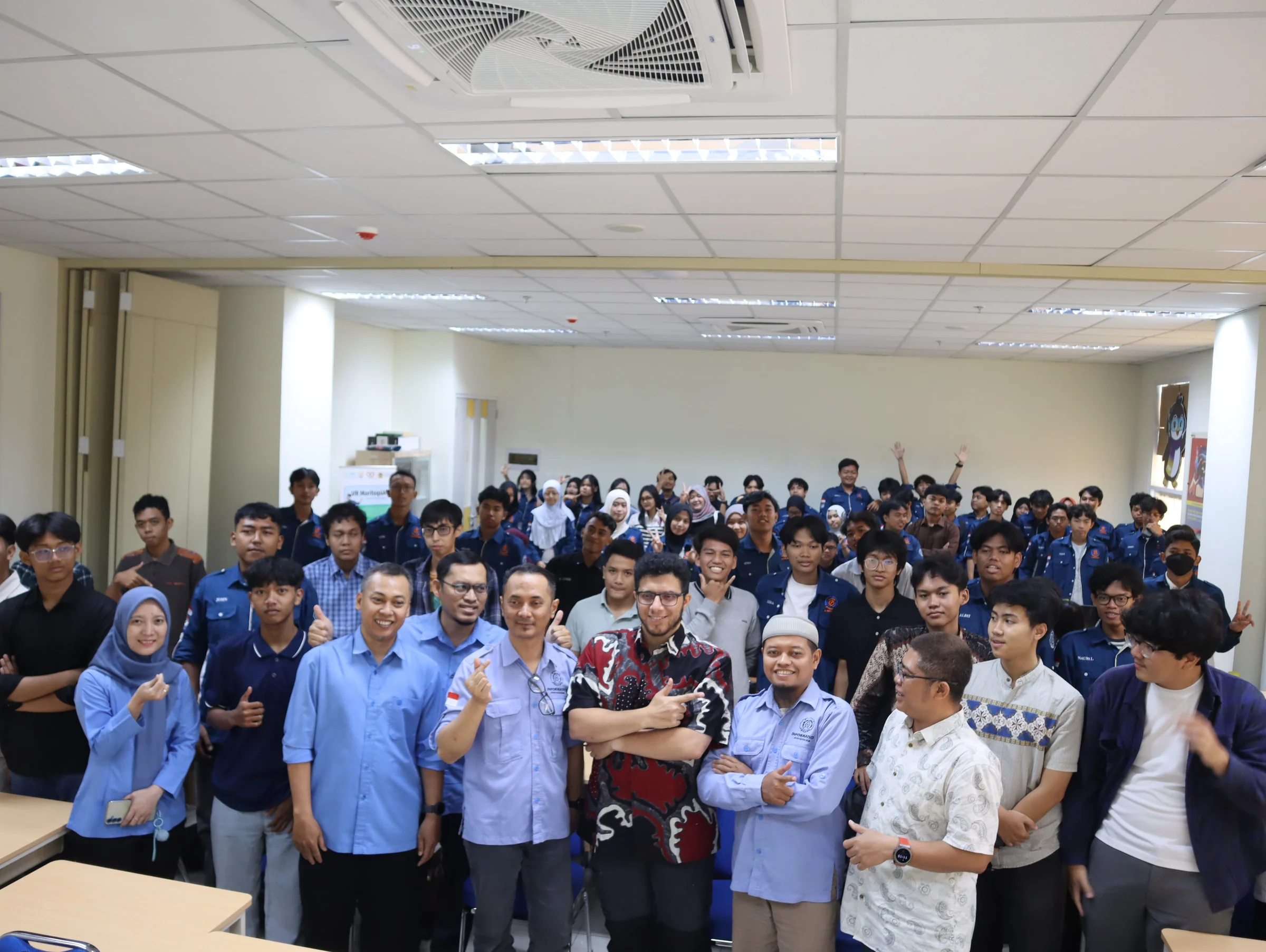
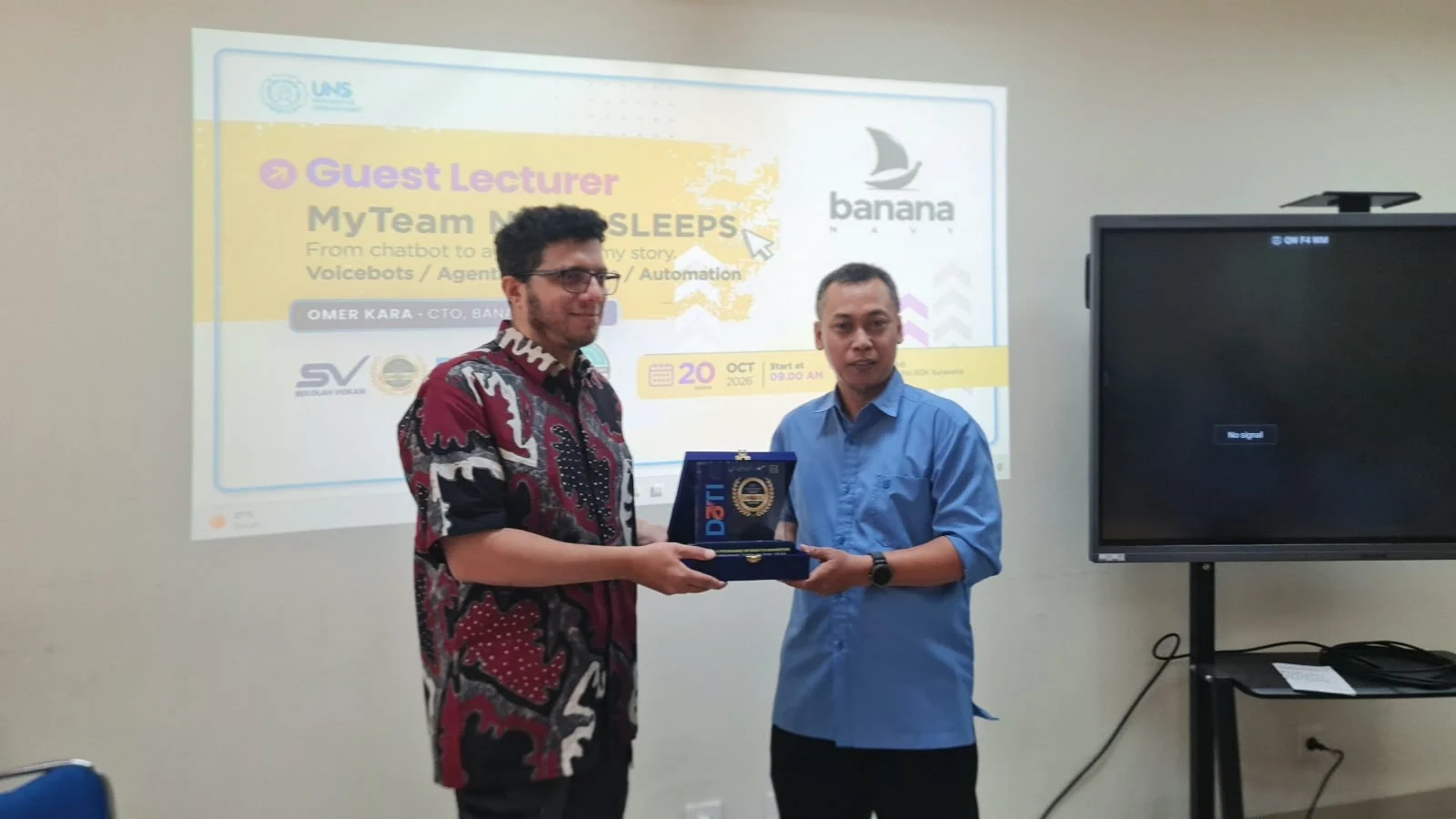
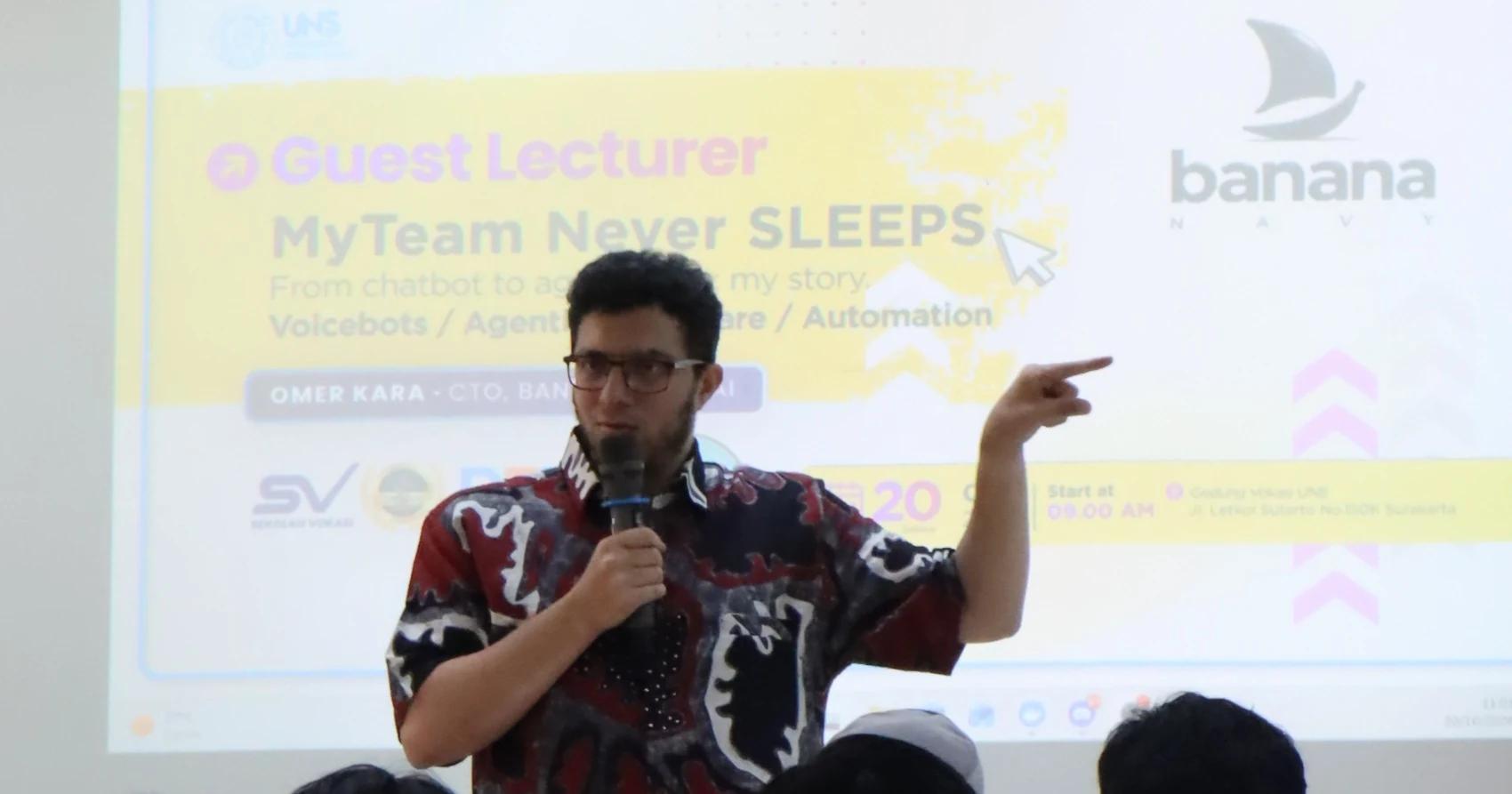
On 20 October, Startika UNS, the applied bachelor programme in information technology and artificial intelligence at Universitas Sebelas Maret, opened its doors to us. The brief was clear: show students what AI agents and automation really change in a business. The room was full and the welcome was warm.
Banana Navy is a small company in Belgium that builds voicebots, AI that answers the phone. Behind the scenes, a team of AI agents works with us: programs that carry out tasks, not only chat. That way of working, with its successes and its mistakes, is what we came to share.
From an assistant that talks to a team that acts
Like many, we started with chatbots. They answer well, but once the conversation is over, the work is still waiting. The real change came with agents, AIs that act on their own: they open files, run programs, send messages. Then with teams of agents, where each one checks another's work. At the end of the chain there is always a person: the one who sees the real world and decides.
A temple built day and night
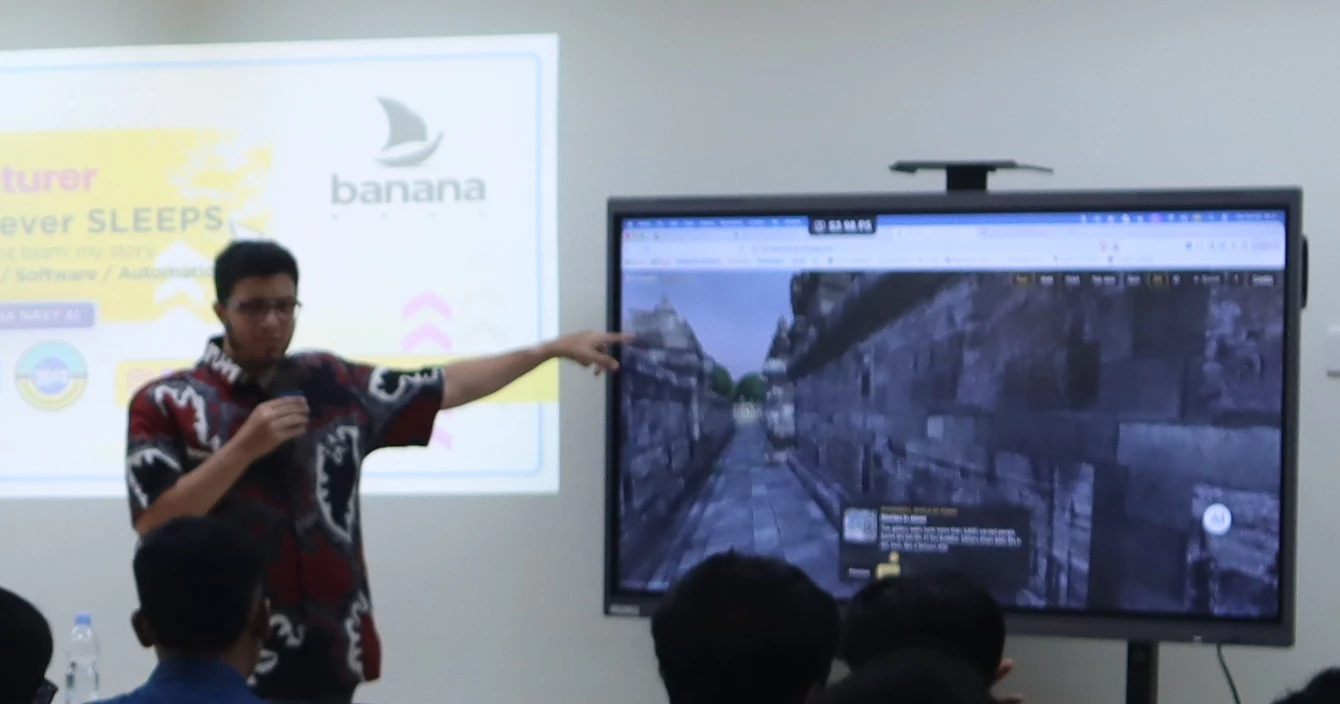
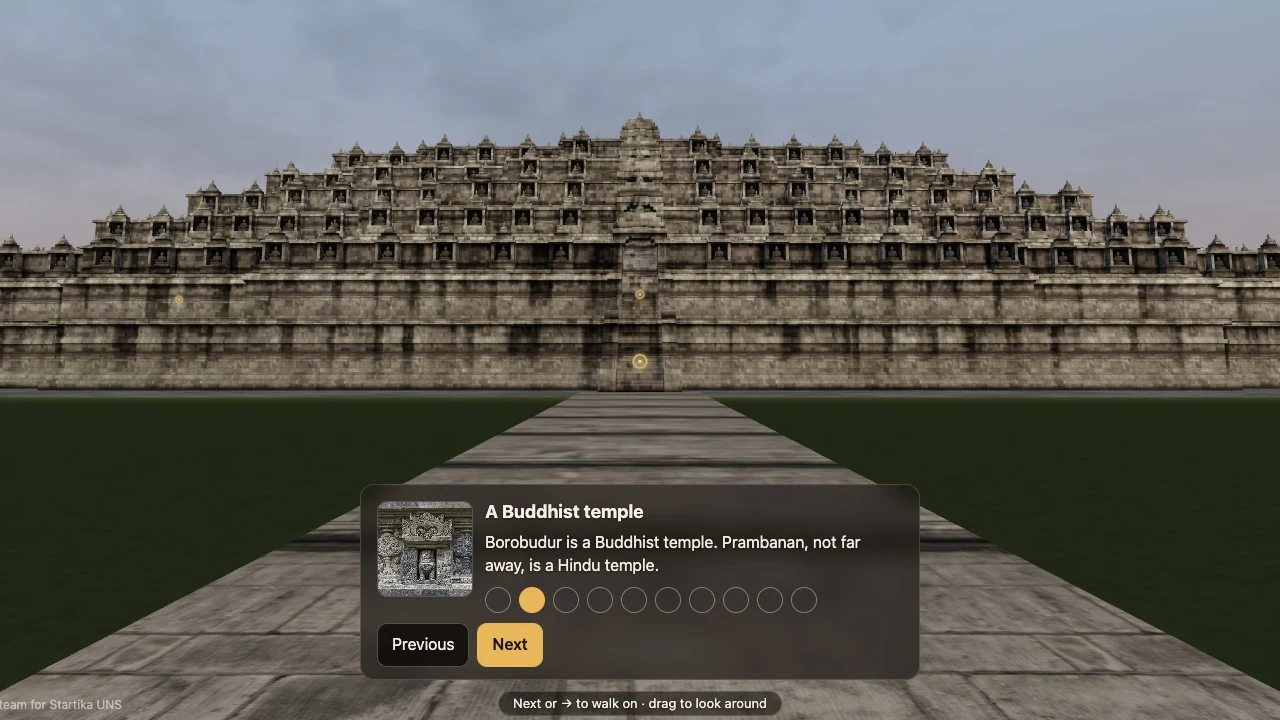
For the lecture, we wanted to show rather than explain. Our AI team built a 3D demo website of Borobudur, the great Buddhist temple of Central Java. Claude, a paid AI similar to ChatGPT, drew up the plan, modelled the temple and checked every step. The code was written by free AI models running on our own computers in Belgium. From Sunday to Tuesday morning, day and night, even while Omer slept, the team went through eleven versions.
- 01PlanA paid AI draws up the plan and models the temple.
- 02BuildFree agents write the code, on our own machines, day and night.
- 03CheckAnother AI compares the result with the picture.
- 04DecideA person understands the work and says yes.
That is where the economics lie. The paid AI only does the short work that takes thinking: planning and checking. The long work runs on our own machines, where it costs little more than electricity. That is how a small company gets a big team.
“Done.” It was not.
Yet the most useful lesson was not the temple. It came from its failures. One of our agents handed in its work with a grade: “DONE, 9/10”, a score it had given itself. A few lines further down, it admitted: “I cannot open a browser here.” It had graded a page it had never seen. When a second AI, in charge of checking, looked at the picture, it found a flat grey slab where a stone path should be. A new task fixed the mistake, which, as it turned out, came from the instructions Claude itself had written.
agent   › … DONE, 9/10.
agent   › I cannot open a browser here.
checker › Not yet. A flat grey slab, not a path.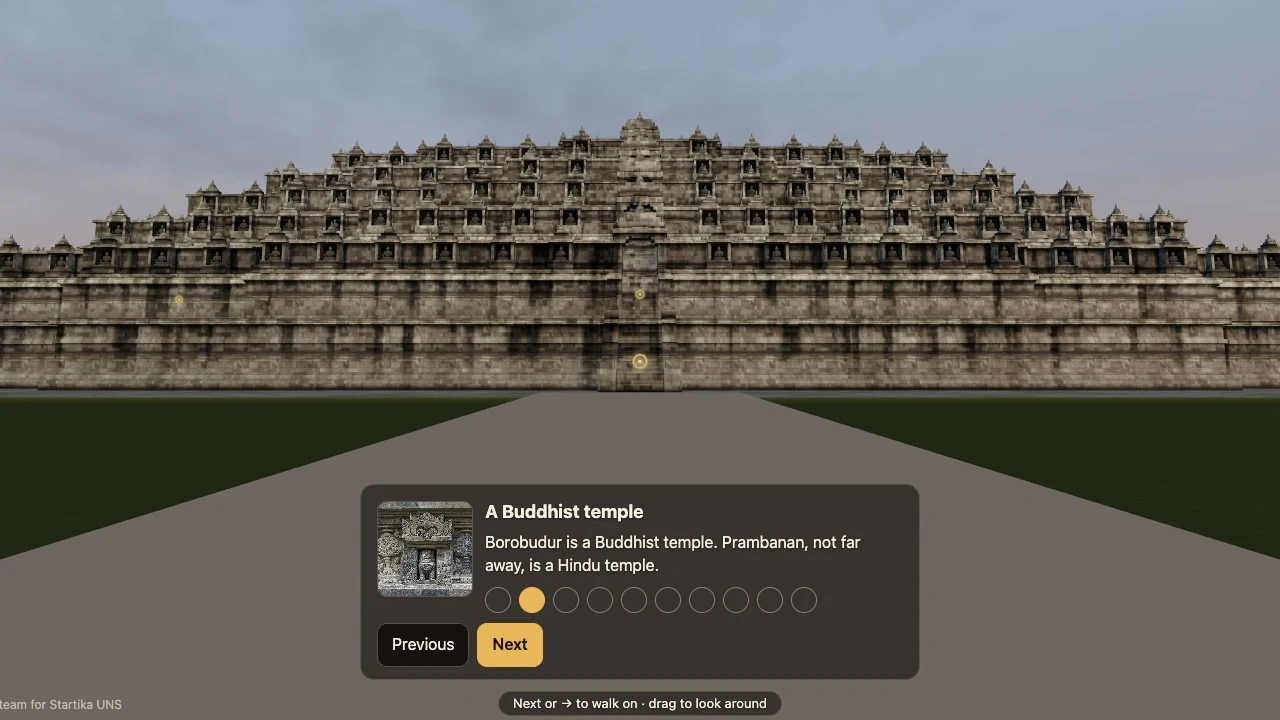
It was not a one-off: by the morning of the lecture, we had counted 34 such cases. An AI often does not see its own mistakes. Another AI, or a person, can.
What matters goes in the program, not in the prompt
Our voicebots taught us the same thing in another form. Before handing one of them to real callers, we tested it with more than 800 practice calls, where a computer played the caller. Real calls still found what the tests had missed: one caller insisted, and the bot transferred the call to a closed department, against the rule in its instructions. So we moved that rule into the program around the AI. Since then, the bot simply cannot send a call there. As Omer puts it: “An AI can be convinced. A program cannot.”
Real use also taught us that a bot that answers well is not enough: the messages it left for the staff after the calls were hard to use. The fault was in what we delivered, and only real use revealed it.
You are the lighthouse
From all this, Omer drew a simple rule for the students: if you do not understand the work, do not approve it. The danger is not that AI is stupid. The danger is that nobody checks any more. The AI is a ship in the dark: it only sees what you show it. “You are the lighthouse,” he told them. “You see the real world. You give the direction.” Someone must understand the work and say yes. That someone can be them.
What it means for a business
None of this requires a large organisation. The habits that made the difference for us apply to a small shop as much as to a large company:
- Start with the problem, not the AI. Not every job needs AI: fixed rules are often enough.
- Write down what “done” means before the work starts.
- Never trust a single check: another AI, or a person, looks at the result.
- If something must never happen, block it in the program. Asking the AI nicely is not enough.
- Never put client data or passwords into an online AI without permission.
In fact, the way we work fits in one sentence: the best AI designs, a free AI team builds, and a person decides.
Omer's advice: step out of your box
Omer closed his lecture with advice for the students: explore every possible profession. “You now have access to an incredible tool, a huge encyclopedia that lets you practise many more professions.” Generating images, music, videos: there are no limits any more, and staying stuck in a single discipline is no longer valued today.
His invitation comes down to three kinds of curiosity: explore how all of this is done, learn to handle different AI profiles with different skills, and know how to control them to build systems that are solid and can scale. Engineer, developer or anything else, everyone must be able to do what AI does, and build skills in management, governance, creativity, critical thinking and systems thinking. That is what lets you move forward, and succeed far better than the competition.
- Management
- Governance
- Creativity
- Critical thinking
- Systems thinking
Now it is their turn
The students' questions went straight to the practical: how to improve the program around an agent, what engineers call a harness, and how to connect AI tools to an agent. So that the learning goes on after the lecture, a free kit in simple English has been online since that same day. Since 21 October it also has six hands-on lessons that work on a phone, including one that shows, step by step, how to give an agent its first tool.
- The learning kit: my-team-never-sleeps.pages.dev/learn
- The Borobudur demo website: borobudur-3d.pages.dev
Terima kasih
Thank you to Startika UNS for the invitation and the warmth of the welcome, to our host, Eko Harry Pratisto, Ph.D., and to every student who took the microphone. Terima kasih: thank you.
Written with our AI team. Reviewed and approved by Omer Kara.